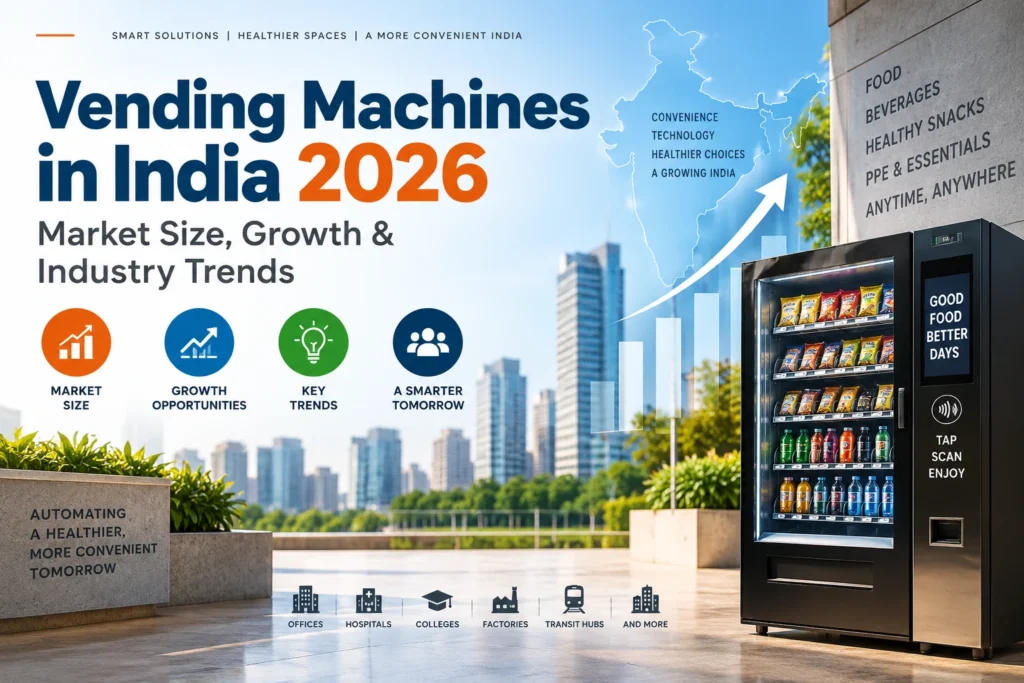
Automated retail is evolving in India from the mere dispensing of snacks and beverages. Vending machines are finding their way from offices and hospitals to colleges, factories and public areas, and are becoming a handy solution for quick delivery of products, while requiring less staff. Along with UPI payments, the vending machine sector in India is also gaining a significant boost from connected technology and evolving consumer demands.
Key Market Stats
- Market value, 2025: USD 970.5 million
- Installed base, 2025: ~358,000 units
- Projected revenue CAGR: 10.84% to 2030
- Projected unit CAGR: 15.53% to 2030
- Projected Market Value 2030 : USD 1,623.5 million
- Projected Installed base, 2030: 736,000 units.
How big is India's vending machine market?
The Indian vending machine industry is rapidly growing, offering businesses a convenient, automated and cashless alternative to serve customers and employees. Next Move Strategy Consulting predicts the market will grow from USD 825.5 million in 2024 to USD 970.5 million in 2025. It is expected to grow to USD 1,623.5 million by 2030, with a growth rate of 10.84% CAGR.
Year |
Market Value (USD Mn) |
Installed Units |
2024 | 825.5 | 289,000 |
2025 | 970.5 | 358,000 |
2030 (Projected) | 1,623.5 | 736,000 |
The more interesting part is the comparison of revenues and unit growth. Revenue is expected to grow around 10.84% and the installed units are anticipated to expand at 15.53%. This indicates deployment is outstripping market value growth, which indicates increased affordability, machine mix changes, and may be a reduction in the average revenue per unit.
Why market estimates differ across reports
Market numbers can vary widely among the various research companies due to different methodologies. For instance, IMARC predicts the Indian market will reach USD 728.2 million by 2025 and USD 1,041.7 million by 2034, growing at a 3.94% compound annual growth rate; Next Move estimates the market at USD 1,623.5 million by 2030.
The distinction may relate to the fact that one report will measure sales of machines and installed equipment while another will measure vending revenue or the overall value of the product generated by the machines. Before comparing numbers, always check the methodology, baseline year, market definition and forecast period.
Where is vending demand concentrated in India?
Demand is greatest in urban areas where there is a mix of big workplaces, lots of potential for foot traffic, tech savvy and a lack of time for traditional purchases.
Delhi NCR is still a big market. According to MarkNtel Advisors, there will be over 25,000 hot beverage vending machines in operation in the region by 2026, which will make the region the largest in their analysis. The other major markets include Mumbai, with its large corporate, commercial and retail ecosystem.
Various other cities such as Bengaluru, Pune, Hyderabad and Chennai also have a potential demand due to the concentration of offices, IT jobs and workplace organisation. These are demand proxies and not a statement of actual number of installations.
Tier-2 cities like Coimbatore, Indore, Jaipur and Lucknow are also catching up because of their increasing networks of suppliers and services. Healthcare and education are other areas of growth, as hospitals and colleges look to the potential of automatic retail in the vending of snacks, beverages and essential goods.
Who is using vending machines the most?
The most robust user segment continues to be the corporate environment, where the hot beverage vending machine market is about 46% of total, according to MarkNtel Advisors’ analysis. The tabletop machines make up approximately 70% of the installed base as they are suitable for small office spaces. Premix systems account for about 64%, but with new trends in beverage consumption, fresh-milk solutions are becoming more popular.
Other institutions, such as offices, hospitals, colleges, factories, PSUs, and other institutional settings, are becoming important users. These settings are suitable for facilities that don’t have to operate a full-time counter and pantry.
Machine types and where they fit best
The type of machine that is selected should depend on location, footfall, product type, and hours of operation.
Machine Type |
Best-Fit Locations |
Primary Use Case |
Coffee / Hot Beverage | They function in offices, hospitals, colleges, and factories. | Tea and coffee are available 24×7 hours a day without depending on the pantry. |
Snacks | IT parks, campuses, and hostels are the best locations for snacks. | Great for in-between meal snacking. |
Cold Beverage | Factories, Gyms, outdoors, and malls are the best locations for Cold Beverages. | Hydration and summer seasonal demand. |
Combo | Small offices and clinics are the best locations for combo. | One machine to serve two types of customers. |
Frozen / Hot Food | Night shift BPOs, hospitals, 24 x 7 plants are the best locations for frozen or hot foods. | If a canteen is closed, a meal will take the place of a snack. Meals instead of canteens. |
Hygiene / Sanitary | Hostels, colleges, PSUs are the best locations for hygiene or sanitary. | Ongoing needs assessment and ongoing support for welfare, accessibility and compliance |
Check our coffee vending machine, snack vending machine and cold beverage vending machine pages for specific solutions. Check our vending machine price in India guide for pricing details.
What's driving growth in 2026?
Automated retail is becoming more appealing thanks to a few changes in 2026. The most significant change is that technology is no longer a bolt-on feature; it’s a customer expectation.
- The days of vending being only for the wealthy and well-bred are over: Vending would work best in a cashless society such as India, and UPI is now an essential criterion.
- IoT and AI are enhancing operations: Connected machines can detect stock levels, performance, and so on, enabling predictive restocking and maintenance.
- Hybrid workplaces are altering pantry models: Companies can leverage automation to supplement or decrease traditional pantry staffing.
- Healthy snacking is growing in popularity: Millets, nuts, roasted and air-puffed snacks can help operators please more health-conscious customers.
- The direct-to-consumer vending channel is being considered by FMCG brands: Companies like Coca-Cola, ITC and Nestlé are more relevant with vending-led distribution and visibility strategies.
- Specialized vending (Pharma and essential product vending) is evolving: If appropriate, controlled access and identity-based authentication are possible in specialized vending.
- New micro-markets and smart lockers are developing: Such types of formats have the potential to expand automated retail beyond a single product dispenser.
These trends are driving the evolution of vending from a standalone retail channel to a connected retail channel.
Challenges holding the market back
Not all locations are profitable when they experience growth. Footfall dependency is still very relevant, as if there is not enough traffic, sales will be down and payback will be up. In addition to this, operators are also experiencing problems of service in tier-2 and tier-3 cities, higher restocking and logistics costs, and compliance with FSSAI and GST (if applicable). Machine operation and maintenance, and responsible disposal of e-waste should also be taken care of.
Location economics, product demand, access for servicing, and compliance requirements should be assessed prior to deployment. Investment required to get a vending business started is detailed in our investment planning guide.
Outlook to 2030
The prospects continue to be good. According to Next Move Strategy Consulting, the installed base would be around 736,000 units by 2030, and market revenue will be USD 1,623.5 million.
The market is also segmented, with the top five accounting for approximately 48% of the market as per MarkNtel’s analysis, meaning there is a scope for regional operators and specialised players.
Vending is growing around the world as well, although estimates vary depending on methodology. IMARC forecasts the global market to reach USD 22.3 billion by 2025, and USD 31.9 billion by 2034.
FAQs
How big is the vending machine market in India?
Next Move Strategy Consulting estimates the vending machine market in India to be worth USD 970.5 million in 2025. It is projected to reach USD 1,623.5 million by 2030, growing at a CAGR of 10.84% during 2025–2030.
How many vending machines are there in India?
As per Next Move Strategy Consulting, there were approximately 358,000 vending machines installed in India in 2025. The installed base will grow to around 736,000 units by 2030, but at a slower rate than revenue growth.
Which city has the most vending machines in India?
According to MarkNtel Advisors’ hot beverage vending analysis, Delhi NCR is recognized as the biggest hot beverage vending market with over 25,000 hot beverage vending machines expected to be operational by 2026. Mumbai is named as the second largest market.
Which sector uses vending machines the most in India?
One of the biggest user groups is corporate workplaces. The corporate sector accounted for around 46% of the hot beverage vending segment, as it is convenient and popular with the employees, according to MarkNtel Advisors.
What licenses are needed to operate a vending machine in India?
Requirements vary according to the machine sold and where the machine is used. Depending on the business and its location, food and beverage vending businesses might be required to have the appropriate FSSAI registration or licensing, as well as the required GST registration if applicable, and any local permissions that may be needed. Operators should check their present requirements prior to installation.
Conclusion
In India, the vending machine space is not just confined to packaged snacks and coffee. UPI payment, IoT monitoring, healthier products, smart inventory control, and new retail locations are all enabling a wider automated-retail opportunity. The growth is strongest in the corporate sector, but other areas like hospitals, colleges, factories, campuses, and public spaces are providing further opportunities. Meanwhile, operators have to pay attention to the management of location selection, servicing, restocking, compliance, and operating expenses. In the current market where businesses are contemplating the next phase of their retail automation efforts, XYZ can serve as a trusted partner to assess solutions, deployment needs, and vending opportunities in India.