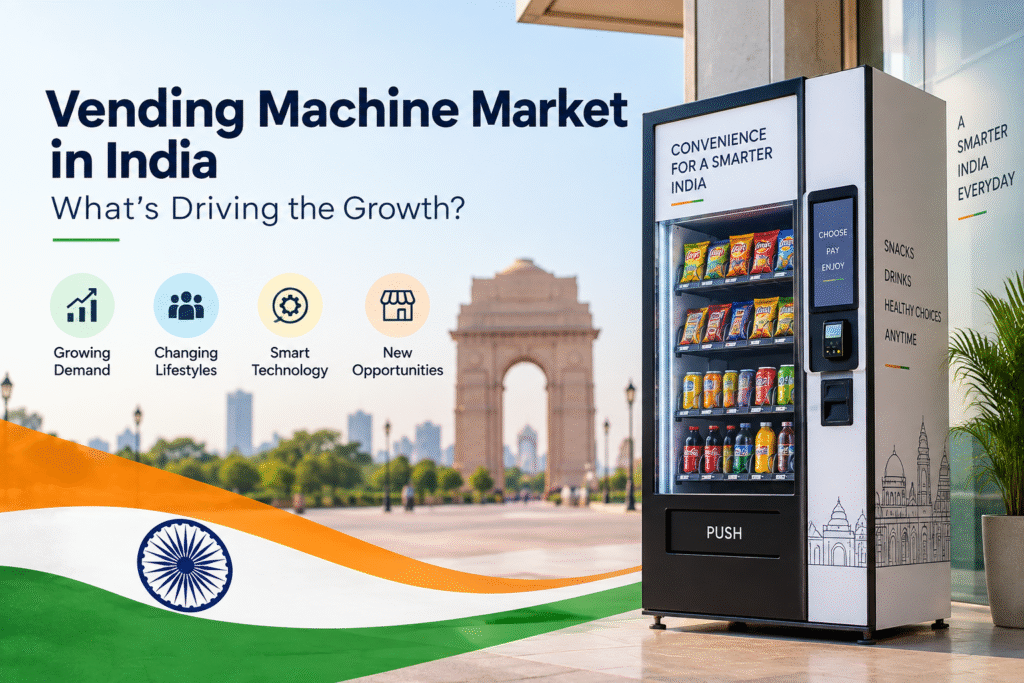
The vending machine market in India will grow from USD 728.2 million in 2025 to USD 1,041.7 million by 2034, according to IMARC Group. The vending machine business in India is growing beyond snacks and drinks; cashless transactions, automation, connected vending machines, and evolving consumer preferences are driving adoption. This report analyses the market insights, growth drivers, technology trends and sectoral demand drivers shaping the market in 2026 and beyond. It’s for business owners, facility and administration managers, FMCG brands, franchise investors and B2B decision makers considering automated retail.
India Vending Machine Market Size 2026 — Key Numbers
The updated IMARC Group evaluation supplies a benchmark to comprehend the vending machine market size in India. It bases its report on the year 2025 and projects the market till 2034.
Market snapshot
| Metric | Figure |
| Market value, 2025 | USD 728.2 million |
| Forecast market value, 2034 | USD 1,041.7 million |
| CAGR, 2026–2034 | 3.94% |
| Forecast period | 2026–2034 |
Source: IMARC Group, 2026.
The numbers reflect growth, not a monthly uptick. According to IMARC, the growth of smart, cashless and automated machines is helping them become more popular; and offices, hotels and public spaces are key demand areas.
Other market research estimates are even higher, with 6Wresearch predicting 6Wresearch predicts a CAGR of 9.1% till 2032. These estimates are not compatible for aggregation as research firms may use varying definitions of the market, as well as different datasets and methodologies.
If businesses are evaluating the vending machine industry in India, one of the important lessons learned is not just the growth percentage. The market is shifting towards technology-driven, cash-less and location-specific retail stores.
Digital payments and UPI adoption: Cashless transactions are the core of automated retail. QR codes, mobile wallet payments, and other digital payment solutions are designed to make payments easier for the consumer, and vending machines can run without relying on cash handling. Adoption of cashless payment methods is recognized as an impactful market driver by 6Wresearch, as well as by IMARC. Payment flexibility may make machines appropriate for additional locations and customer groups for operators.
Workplace automation demand: Offices, hotels and public areas are becoming more important locations as vending can be used to deliver products without a constantly manned retail counter. One of the key market drivers identified by IMARC is the increasing demand in offices, hotels and public spaces. Automated dispensing can be used to augment existing pantry, cafeteria, or convenience programs and help provide access when services are not offered during regular hours for facility managers.
Tier-2 city expansion: Vending is expanding beyond metropolitan areas. As per IMARC, the penetration of smart vending is increasing in both tier-2 and metro cities. Organised workplaces, education institutions, healthcare facilities and commercial spaces are growing in other metros, providing vending providers with new deployment environments. So, vending machine market growth in India is now a complete picture of geographic expansion as well as deeper penetration into the existing urban centres.
Health, convenience and changing consumption: The old consumers are more demanding in terms of food, beverage and everyday products, as they seek convenience and rapid access to the product. Meanwhile, healthier product offerings, like nutritious snacks, can be offered in vending formats. IMARC recognizes the demand for vending machines that provide healthy food and cashless transactions and automation as growth factors. This opens up avenues for operators and brands to match machine assortment with the needs of particular areas.
Sector-Wise Demand — Where Growth Is Fastest
The demands are very different depending on the number of customers that pass through, their hours of operation, their demographic and product needs at each location.
| Sector | Why Demand Is Rising | Typical Machine Type |
| Corporate offices | The ease and accessibility for employees. | Beverage/snack |
| Hospitals | Extended operating hours | Beverage / essential products. |
| Colleges | Convenience and accessibility for students | Snack/beverage |
| PSUs/government | Workplace and visitor facilities. | Beverage/combo |
| Malls & retail | To buy on impulse and for convenience. | Snack/beverage |
| Public transport | Customers are strongly interested and eager to buy. | Beverage/snack |
It’s no surprise that the vending machine business in India is wider than the standard coffee machine in the workplace because of the diversity in the applications. The product mix, payment system, and operating model are unique to different sectors.
Technology Trends Reshaping the Market
UPI and cashless as the default: Cashless payment is becoming an integral part of the modern vending experience. 6Wresearch believes that cashless payment will be the key payment-mode segment in the future with the increasing penetration of digital wallets, mobile payments, and QR codes. This helps in minimising the hassle in transactions and renders the vending more suitable for the digital buying environment in India.
Internet of Things (IoT) and remote monitoring: Connected machines can share real-time data with operators on inventory and machine performance. IMARC emphasizes the following key technology advancements: remote monitoring and predictive maintenance, which help operators detect trouble before it happens and minimize downtime. This can help with more data-centric servicing and replenishment for larger networks.
Businesses evaluating connected solutions can explore a smart vending machine for technology-focused deployment requirements.
AI and personalization: Using purchase data can aid companies in understanding the effectiveness of their products in various store locations. IMARC points out that companies can leverage customer tastes and purchase patterns to customise their product lines, and that connected technology can help with improved availability and operations decisions.
Sustainability: As businesses consider the impact of automated retail, more sustainable machine designs and packaging options are growing in importance. Sustainability considerations may impact equipment selection, product offerings, packaging, and long-term operating practices.
The new developments are contributing to the ecosystem of the vending machine industry in India to be more data-driven, connected, and responsive to retail operations.
What This Means for Businesses
For offices and institutions: Vending can be used in order to offer the convenience of beverages, food, and chosen daily products during long operating hours. It fits in with the cafeteria/pantry service option for facilities with regularly shifting schedules, without the need to have a specific counter for each purchase. This should be directed towards matching the type and product selection of the machine with actual user requirements. However, location assessment is still a critical factor as convenience is a worthless value unless an employee, visitor or student can readily reach the machine.
For FMCG brands: Vending is another channel between the traditional retail experience and direct engagement with consumers. Brands can use machines to put selected products in offices, campuses, transport places and other high-traffic areas. This can offer an extra distribution touch point and enables the product mix to be tailored to the specific buying habits of each area. Vending is likely to offer the best opportunities to those brands who view it as a component of a broader omnichannel approach to sales instead of a sales channel in its own right.
For investors and franchise partners: there are a few different ways to deploy and operate automated retail: managed deployments and rental-based. Before investing, investors should evaluate the location quality, product types, infrastructure, service, and operational needs. If you are thinking of a structured expansion plan, you might want to consider vending machine franchises, or if you don’t want to purchase equipment, then you can check out vending machines on rent.
Looking to deploy vending? Before installing, check the business model, location, and machine functions.
Challenges to Watch
- Maintenance and servicing infrastructure: Poor technical support can lead to downtime; plan maintenance and service of vending machines.
- Location dependency: Low traffic levels may lead to low machine utilisation; validate traffic and user demand before deployment.
- Initial investment and payback: These will depend on the type of machine and operating model — create a location-specific financial assessment.
- Product spoilage and inventory: Monitor and forecast demand for perishables, and use scheduled replenishment.
- Equipment selection: Companies should make comparisons among equipment without getting confused with the market research or equipment cost; see vending machine price in India separately.
Outlook for 2026–2030
Though projections differ from research outlets to outlets, the vending machine industry in India is expected to continue growing till the end of this decade. According to IMARC’s latest evaluation, the market is expected to reach USD 728.2 million in 2025, and USD 1,041.7 million by 2034, with a 6Wresearch forecast of a 9.1% higher CAGR through 2032.
As the adoption of automation in retail continues to grow, industry analysts are estimating the Indian market to be valued at USD 1 billion. What really matters is the transition away from standalone dispensing machines and towards connected retail points, connecting payments, monitoring, product information, and automated service.
Conclusion
India’s vending machine industry is moving into a more technology-driven future, with digital payments, workplace automation, growing urbanization and connected machines to meet the growing demand. IMARC’s forecast is a reasonable benchmark; other research suggests the rate of growth could be higher, depending on the methodology and market definition. For businesses, the answer isn’t a one-size-fits-all approach to vending, but rather figuring out where to place them, what machine format to use, what products to stock, and how to operate them. With the growing adoption of the use of the automated-retail industry in various offices, healthcare, education, retail, and public areas, Unicorn Vending can assist businesses in assessing the evolving automated-retail market and determining appropriate opportunities for their needs.
FAQs
How big is the vending machine market in India?
According to IMARC Group, the market reached USD 728.2 million in 2025 and is projected to reach USD 1,041.7 million by 2034, at a 3.94% CAGR during 2026–2034.
What is driving vending machine growth in India?
The major factors are cashless payments, office automation, growth in tier-2 cities, convenience for the customers, and the growing demand for healthful vending options.
Which sectors use vending machines the most in India?
The demand is dependent on footfall, operating hours, and convenience factors, and the important application areas include corporate offices, hospitals, colleges, government buildings, malls, and public transportation centers.
Is the vending machine business profitable in India in 2026?
Location, product mix, operating costs, and utilisation are important determinants of profitability. For businesses looking to grow, they may want to look into a vending machine franchise.